

Summer campaign
In the border region of Huong Hoa, there are 1900 teenagers with too little knowledge of sexual matters. Their parents also want to gain knowledge and self-confidence so that they are able to discuss delicate subjects.

Summer campaign
In the border region of Huong Hoa, there are 1900 teenagers with too little knowledge of sexual matters. Their parents also want to gain knowledge and self-confidence so that they are able to discuss delicate subjects.
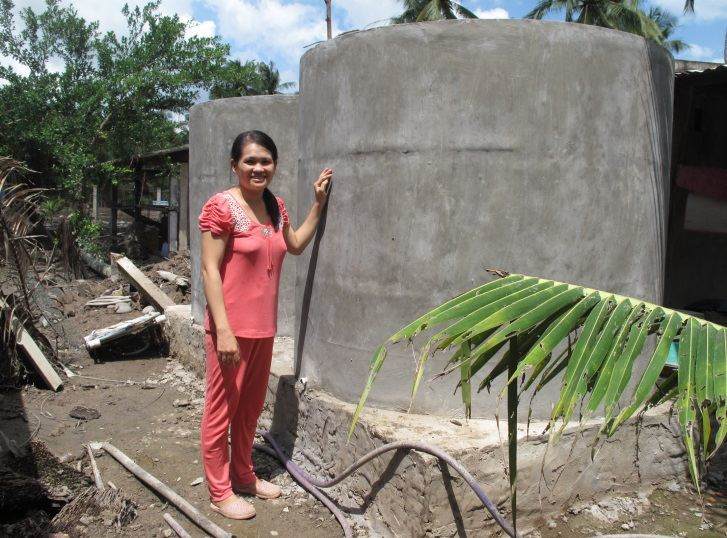

Serious drought in Ben Tre 2016
The serious drought and salinity in Ben Tre other Mekong river delta provinces of Vietnam in the beginning of 2016 was declared as a natural disaster by the government. The shortage of fresh water for human consumption and agricultural production is especially affecting poor people living near the coastal areas.

A family lacks fresh water
Global Climate change is increasingly making direct impacts on the living situation of huge numbers of people in developing countries whose livelihoods depend strongly on natural conditions. People who earn their living from agriculture, fisheries and aquaculture are the most vulnerable. Natural events such as typhoons, floods, droughts and saline intrusion are happening more often and more intensely in recent years, eroding people’s assets and investments and pushing many back into poverty. The salinity in the main rivers (4‰ isohaline) had intruded about 45-65km from river mounths and the whole of Ben Tre province was covered by water with a salinity of 1‰. More than 20,000ha of rice in Spring-Summer crop had been lost. About 8,500 ha of fruit trees were partly damaged by the drought and salinity. More than 98,000 households (about 400,000 people) lack fresh water because they do not have enough containers to store rain water.
MCNV quickly responded to the climate change issues in Ben Tre for the poorest people who are suffering most from the drought and salinity. The aim of MCNV is to create a sustainable mechanism which could help the poor maintain and step by step adapt their livelihoods to the more difficult natural conditions.
From May 2016, MCNV provided loans to help families to build big water containers to retain more rain water for human consumption during dry season. Loans from MCNV microfinance project in Binh Dai district allow poor family to build high capacity water container of about 3m3 each. Loans should be paid back monthly over 12 to 24 months so that it is convenient also for the poor. Up to August 2016, 150 households have borrowed from the MCNV project to build 286 big water containers with total capacity of 858m3. The loans for water containers will be available throughout this year and in coming years to create access for the poor to store more fresh water. Many more people can be supported by loans than with one time grant support.

A mushroom production workshop
With financial support from Jumpstart Foundation, MCNV collaborates with the Ben Tre provincial Women’s Union to establish women cooperatives, which provide stable jobs and income for poor women. These jobs help poor families to adapt to climate change by reducing their dependency on farming. Five women cooperatives will be established in Binh Dai and Ba Tri district for the production of mushrooms and dried fish, that will create jobs for at least 100 poor women. These cooperations will be the first test for more productive models for poor women in the future.
MCNV would like to establish a livelihood adaptation knowledge website to share our field experience to help poor communities to improve their livelihoods by adapting to climate change. We believe this could be very helpful for other places and people who are facing the same problems.
At the same time, MCNV also looks for Corporate Social Responsibility programs to supply water containers to kindergartens, commune health centers and friendship houses for extreme poor people in Ben Tre. Creative trainings on adapted livelihoods should be provided widely to raise awareness for everyone to better prepare them for unavoidable climate change.

First members of dried fish women cooperative
Climate change impacts on livelihoods are very complex and many more poor communities will need comprehensive support to adapt to new situations. MCNV expects to find additional development partners to do practical field research and bring innovative methods that could help poor communities to stablise their lives and overcome the additional challenges from climate change.
This intervention records the first foot print of MCNV into the Climate Change sector. MCNV commits to support poor communities to adapt their livelihoods with best effective and innovative approaches to make this effort sustainable and helpful to poor people.


HIV/AIDS epidemic has become the most emerging public health problems in Vietnam since 1990s. By the end of year 2015 there was a total of 227,000 people living with HIV while more than 75,000 people have died from AIDS. In estimation about 14,000 new cases of HIV are founded every year.
During 12 years working in HIV/AIDS area, MCNV had a considerable contribution to Vietnam HIV/AIDS situation in establishing and providing support to a community – based organization of women who are living with HIV, called Sunflowers, in seven Northern provinces in Vietnam. The program has contributed to improving access to health care for women living with HIV because of the strengthened referral system.
Beginning in 2004, a group of women living with HIV was established by MCNV’s support. The simple aims were to ensure that, if pregnant, women can access to information and medicine that would help to prevent the transmission of HIV from mother to child. This initial pilot was successful in achieving its goals, and with the generous support of the Royal Netherland Embassy, it was scaled-up to a further three provinces between 2006 – 2009. In its third phase these achievements were consolidated and the model adapted to suit the needs of people living in remote mountainous regions. Then the program covers seven provinces and the Sunflowers group supports over 1,500 women living with or affected by HIV/AIDS and their families.
The Sunflowers groups help to ensure that they can overcome the barriers and obstacles they face to live active and fulfilled lives. This support comes in many forms, it includes: counselling and care at home and in hospitals, support to secure stable livelihoods, assistance with children’s education, and engagement with the community to reduce stigma and discrimination. Over more than 12 years the program has demonstrated that when women living with HIV work together their confidence and self-esteem increases enabling them to become powerful advocates for change and developments.
From 2012, after handing over, the network of Sunflowers had worked more independence with its own steering board of national level, and leaders of each provincial group. The Sunflowers are maintaining supports in improving health care access, income generating, and social by monthly meeting, revolving fund, and many supportive events. From this period, overcoming difficulties, Sunflower maintains its groups and networks with many valuable activities. More than 1,100 women living with HIV frequent attend the monthly meeting. Living with poor health status, many leaders of Sunflowers cannot be able to have a longer contribute to their group. Sunflower have refreshed themselves by changing most of group leaders and Network leaders and its structure.
In addition, MCNV provides health care insurance to Sunflower members, therefore, 100% of women living with HIV are protected by health insurance. The program also organizes vivid trainings to cultivate skills and knowledge to Sunflowers and their family members. Specifically, parenting skills were provided to grandparents who are raising orphan children. The training, such as hepatitis C prevention, ARV therapy, pig raising skills have been delivered to members of the Sunflower groups.
Currently and in a couple of year MCNV is providing technical and a little financial supports, which is enabling the Sunflowers to be strengthened, and capable to work more independently as a Community Based Organization of women living with HIV, to bring support to women living with HIV continuously.

Huong Hoa is a remote district of Quang Tri province, located in the border area Vietnam – Lao PDR. The district has a total population of nearly 80,000 in which above 50% are people from ethnic groups of Pacoh and Bru Van Kieu. In the villages along the border area where MCNV works, out of total population of 12,353 people, there are 1,999 poor households (16.2%) and 9,835 ethnic minority people (79.6%).
The Pacoh and Bru Van Kieu have no written language and have limited access to educational information and quality health services. They mainly live on growing banana, cassava, corn, and some rice, and practice shifting cultivation on the poor highlands. They work hard but obtain insufficient income to afford health and educational services. Similar to other ethnic minority groups in Vietnam, as a consequence of poverty and low awareness, they lag behind in all aspects of the development process.
As a cultural custom, teenagers of Pacoh and Bru Van Kieu ethnic groups are allowed by their parents to date quite freely, and they are allowed to get married, too, when they are still very young. Having sex is almost unavoidable among teenagers. The problem is that so many of them do not have enough basic knowledge in SRH, putting themselves always at risk of bearing unexpected pregnancy and sexually transmitted diseases (STDs). While SRH is not taught at schools, teenagers in this remote area also have limited access to educational messages about SRH through other channels of information. And even if they are aware of problems related to SRH, they avoid talking about it as it is too much “sensitive” or “private” to talk about.
A baseline survey done with teenagers in this area in 2013 has given shocking data – 56% of teenagers under 16 already experienced having sex, 78% didn’t know how to protect themselves from STDs, 14% of teen-girls got unexpected pregnancy, and 97% didn’t prove that they had enough basic knowledge in contraception.
Since mid-2015, MCNV has launched a project to help tackle this problem. We started with co-creation workshops with some groups of active teenagers and village health workers (VHWs) selected from two piloted communes of A Tuc and A Xing. Co-creation workshops enabled the teenagers to get basic understandings about SRH, analyse their real problems, identify practical solutions and come up with an action plan. A story-based approach was applied so that the teenagers could share true stories that happened as a consequence of unsafe sex practices in their community and, with technical support from MCNV staff and the VHWs, re-formulate the stories in the form of shadow drama and puppet shows. The teenagers then presented the shows in combination with community events and interacted with the audiences about SRH aspects related to the stories. The community events were organized every month by the teenagers with the participation of peer/interest groups – youth football clubs, and RAP and hip-hop groups.
In parallel with this way of behavior change communication, some teenagers also volunteered to sell condoms at home, which was more easily approachable to the young people. In contrast, condoms could be easily found at the commune health stations, but the teenagers would never come there to ask for.
Another solution was to use the photo-story telling technique to tell the stories in the form of animations and shared them on the social media to reach and interact more with the online community. We also used a mass instant messaging service to deliver educational messages about SRH for teenagers in this remote area in a weekly basis.
One of the most significant change, as revealed from 40 in-depth interviews and 4 focus group discussions recently with the teenagers directly involved in the project, is that they have changed their mindsets, attitudes and behaviours about SRH at teenage and actively communicated with their friends, families and neighbours to raise their awareness about this topic, which they never dared to speak out before.
Four small groups of teenagers, about 10 members each, have produced 4 shadow plays and 4 puppet shows and used them for behavior change communication events and for online communication.
An added value of the project was the increase in the teenagers’ power and motivation to make contribution to the community development, which they thought before to be the adults’ affairs. They have become more united for it, as well. There used to be tensions and conflicts among different groups of teenagers, making them not dare to go from one commune to another for fear of being beaten. Now they have become friends, instead.
Further evaluation will be done in the coming time to see changes in SRH knowledge, attitudes and practices among more than 600 teenagers and older young people in these two communes.
We expect to maintain this project in these two communes and upscale it in other three neighboring communes of Huong Hoa district in 2017 and 2018, directly benefiting to about 1,300 teenagers and older young people. In this new phase, we will promote the role of local leaders, parent groups and schools (both high schools and secondary schools) in changing SRH practices among teenagers. In addition, we will collaborate with the district and commune health centres and the Association of VHWs in applying e-health initiatives in SRH communication.
Good practices and lessons learnt from this project will be documented and shared with relevant organisations and networks, such as UNFPA, Barefoot Guide Alliance, ARROW, ADF, WGNRR, and the Vietnam’s health sector and policy makers.

Head Office in Amsterdam
KvK No: 41198048
+31 (0)20 627 0411
info@mcnv.nl
ING bank
IBAN: NL16 INGB 0001 0904 00
BIC: INGBNL2A
Triodos bank
IBAN: NL90 TRIO 0338 5367 60
BIC: TRIONL2U
RSIN: 0028.56.475



Copyright ©2017-2023 MCNV


