Blog

Supporting Ethnic Minority Adolescent Girls: Project Kickoff in Huong Hoa

On August 29th 2017, MCNV collaborated with the Village Health Workers’ Association of Quang Tri Province and the Youth Union of Huong Hoa District to organize a kickoff workshop for MCNV’s new project “Supporting Ethnic Minority Adolescent Girls”. Participating in the event were representatives of the Provincial Health Department, Provincial Sexual and Reproductive Health Centre, Committee for Ethnic Minority Affairs and the authority and relevant parties of the district, including People’s Committee, Health Department, Health Centre, Centre for Population and Family Planning, Department of Training and Education, Department of Labour, Invalid and Social Affairs, Department of Agriculture and Rural Development, Women’s Union and Youth Union, as well as international non-governmental organisations Plan and World Vision.

An assessment carried out by MCNV in collaboration with the Provincial Sexual and Reproductive Health Centre in the first half of 2017 has shown that ethnic minority adolescent girls in Huong Hoa are facing serious health, education and social problems. To evidence, in 2016 in Huong Hoa there were 301 girls out of totally 483 cases who became pregnant at adolescence (counted for 62.3% of the total number of pregnant adolescent girls in the province), 120 cases of child marriage, and 30% of adolescent girls under 15 years old and 50% under 16 started having sex. The ethnic minority adolescent girls lack knowledge and skills in SRHR, face difficulties in accessing quality health and education services, and are affected by local cultural customs and limited awareness of the community.

In 2017 and 2018, the project will be implemented in 6 communes in the border area Vietnam – Laos, including Huong Lap, Huong Phung, Huong Viet, Lao Bao, Tan Long and Tan Thanh. The project’s general objective is to reduce the rates of unwanted pregnancy and child marriage among adolescent girls. Key interventions will focus on (i) building capacity and creating opportunity for personal development for adolescent girls; (ii) improving the access to health, education and social services for adolescent girls; (iii) raising the local authority’s and people’s awareness about the issues related to adolescent girls. A wide range of activities have been planned, including a social marketing campaign for behaviour change communication, setting up clubs and groups of adolescent girls, checking up and counselling on SRH, providing scholarships and vocational trainings for disadvantaged adolescent girls, and improving SRH knowledge and skills for adolescent girls, thus contributing to ending unwanted pregnancy and child marriage among adolescent girls.

*Photo: Ms. Phan Thi Lien, Chair of the Village Health Association, Quang Tri province, was presenting the image and symbol of the project named Mun Arai.
Read more

The 27th Occupational Therapy Australia Conference “Partnership, Inclusion and Innovation”

Perth welcomed us in a very early cold of its mid-winter. Our flights was landed at 2h30 in the morning after a long nearly 13 hour-flight and transferred at Kuala Lumpur airport.

Gotten in a cab, four of us (Ms. Cam Hung- Head of Rehab Department, Hai Duong Medical Technical University (HMTU), Ms. Thanh Van – Head of PhysioTherapy Department, University of Medicine and Pharmacy (UMP-HCMC), Dr. Pham Dung – Country Director of MCNV in Vietnam and my self–as Coordinator of OT Education Program) were shivering with sleepy eyes in that small space which operated by electronic and broke through the quiet and velvet night to the hotel.

A bit exciting to head up to the 27th Occupational Therapy Australia Conference in the upcoming days.

Such a privilege to us – a delegation from Vietnam to attend the 27th OT Australia Conference which was held from July 18th-21st in Perth, Western Australia.

The first day in Perth was Education Day and hosted by Curtin University – one of the leading in OT training courses in Australia as well as in the world. Lots of experience and sharing from universities (Curtin University, Swinburne University, James Cook University, University of South Australia, Charles Sturt University, Deakin University, Griffith University, Australia Catholic University, University of Sydney, La Trobe University, University of Queensland, Monash University…)  who are providing OT education exchanged openly with different topics such as Contextualizing the cultural competency journey of OT, Innovations in project management practice education for student professional development through high quality, strategic and inter-professional opportunities… The two lecturers from HMTU and UMP-HCMC had excited opportunities to discussed innovations in OT education with colleagues from other universities. These discussed topics were valuable and useful directly for the OT Education Development in Vietnam which is undertaken by HMTU and UMP with support from MCNV and granted by USAID from 2015-2020.

Discussed topics were:

  • Innovation in establishing and maintaining partnerships in practice education
  • Innovation in preparing and debriefing students
  • Innovation in preparing and debriefing supervisors for students practice education
  • Innovation in innovation in assessment
  • Innovation in international practice education opportunities
  • Innovation in sourcing funds for practice education
  • Innovation in non-traditional and/or role-emerging practice education
  • Innovation in simulation

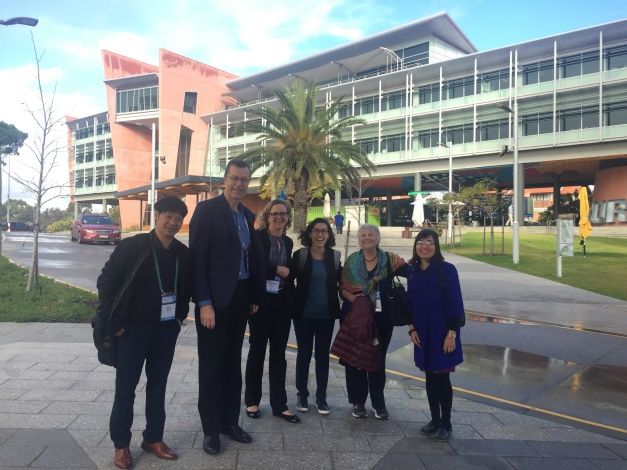
Vietnam delegation at the Education Day hosted by Curtin University.

Photo credit: MCNV

A strong sense of confidence about what we are doing in Vietnam grows among us!

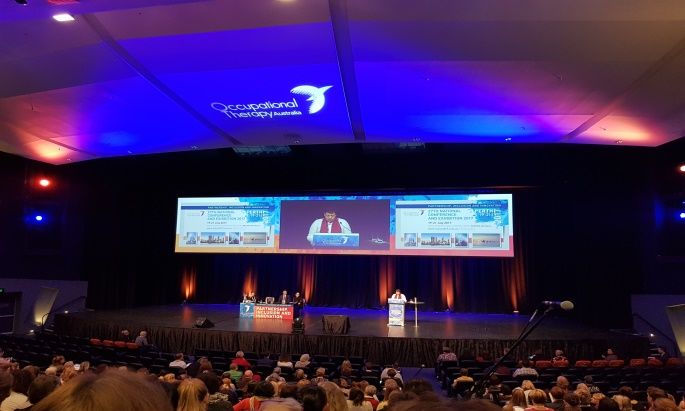
And the second day in Perth but first day of the OT conference was  fulfilled with emotions and pride by very inspired, short and sweet speeches from policy makers, OT practitioner and especially a client who had received OT services after surviving from a bomb suicide in London years ago. More impressive was the rhythm of welcoming to country – traditional custodians of the land sang by an Aboriginal man. So warm and proud.

Opening Session of the 27th OT Australia Conference, Perth city

Photo credit: MCNV

Running from session to session, presentation to presentation, question to answer in such a busiest scientific program from July 19th – 21st, we ran back and forth as shuttles just wanted to learn as much as we can from researchers, practitioners, educators, policy makers, consumers/service-users, managers and students. All is about OT. “The conference was a great opportunity to explore new directions, to learn about enhancements to practice and to participate in discussions about our professional development” Ms. Hung/HMTU said.

Fondly imagined that tea-break times could bring us some air, but meetings and non-stop conversations about OT with colleagues from over the world. That was the times we could visit and view exhibitor areas of practice. Engaged with the exhibition and met with exhibitors and learned about new products and all available assistive devices were exhibited, a pained question hit heart and brain “when Vietnamese people could access to and have these assistive devices in OT services?” We wished could bring them all home. However, ideas for the ADL labs at HMTU and UMP bloomed.

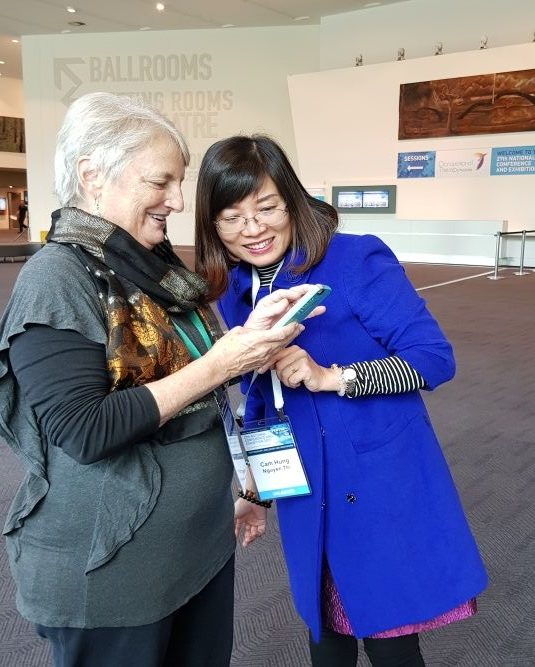
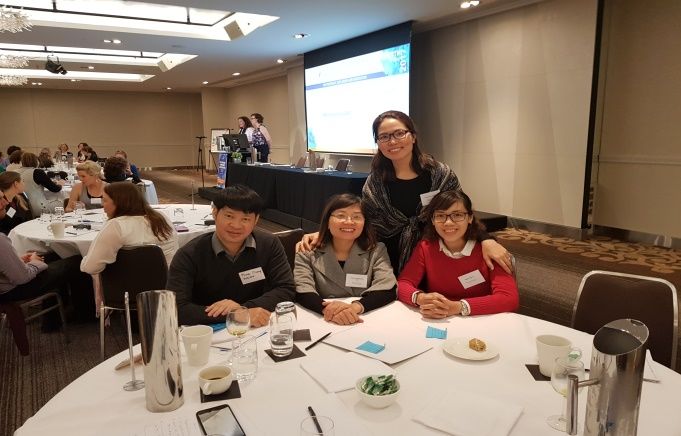
Ms. Cam Hung from HMTU was exchange with a delegate from the USA.

Photo credit: MCNV

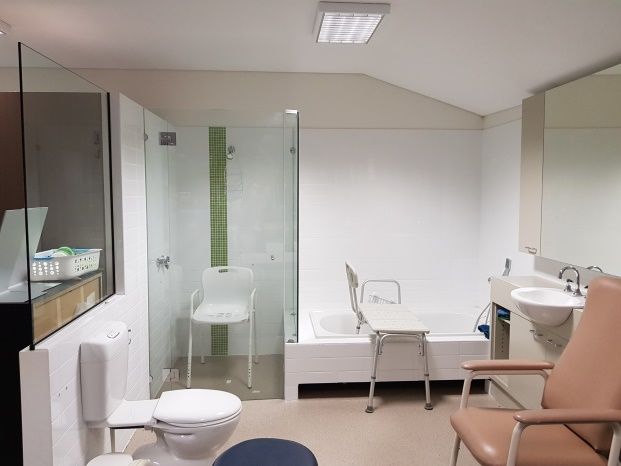
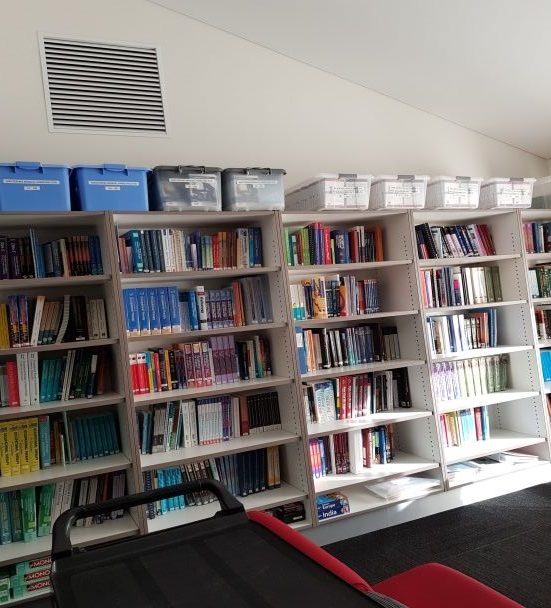
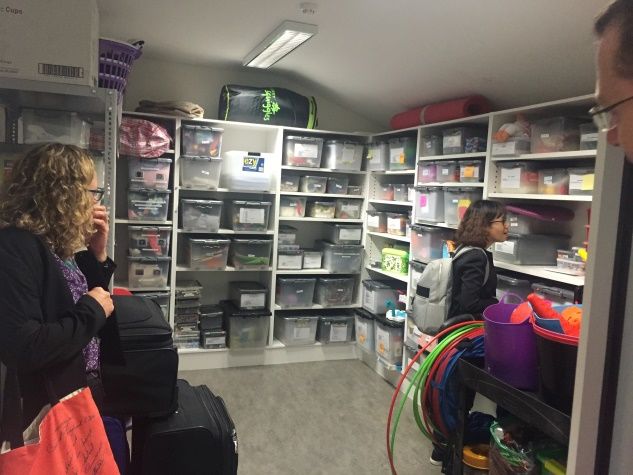
A short visit to the department of Occupational Therapy and Social Work, Curtin University brought us an overview about OT training program – simulation-based education and the OT lab at the university.

Images taken from the visit to the Department of OT and Social Work, Curtin University

Photo credit: MCNV

To end this note, as the President of OT Australia, Peter Bothams spoke in his opening “The theme Partnership, Inclusion and Innovation has never been more apt than now. We are a diverse professional community, and this is one of our strengths as we increasingly find ourselves working in changing dynamic environments where our roles evolve and flex to suit emerging needs, with many occupational therapists pioneering paths for the profession.”

YES – WE – MCNV – proudly stand among pioneers for OT profession in Vietnam!

***

By Tran Quynh Trang – MCNV Program Coordinator

Read more

The first Occupational Therapy (OT) networking workshop in Vietnam

On August 28, 2017, in collaboration with the Vietnam Rehabilitation Association (VINAREHA), MCNV organized the first OT networking workshop in Danang city with the participation of more than 65 OT practitioners and students from across the country and especially OT colleagues from Australia, Japan, UK and USA.

This workshop was an activity under the OT education development program in Vietnam – a component of the “Advancing Medical Care and Rehabilitation Education” project, and undertaken in collaboration between MCNV and Handicap International (HI) and granted by USAID from 2015 to 2020.


Considering as the first OT workshop in Vietnam, it aimed to kick-off the networking of OT professionals as well as create a platform where Occupational therapists can exchange experience in practice and research.

We do hope in the future, more OT conferences and workshops will be organized to bring more exchange opportunities to all OT practitioners in Vietnam.

Some photos from the workshop.

Read more

LAUNCH THE PROJECT ON MALNUTRITION PREVENTION FOR CHILDREN AT AGES UNDER 5 BASED ON AGRICULTURAL SOLUTIONS IN THE MOUNTAINOUS AREA IN PHU YEN

On July 7 2017, MCNV Central Vietnam and the Phu Yen Department of Health organized the project launching workshop on Accessing the Malnutrition Prevention for Children at Ages under 5 based on Agriculture Solutions in the Mountainous in Phu Yen province, period 2017 – 2020 (the NSA project). More than 30 participants taking part in the workshop were members of the Provincial/District People’s Committee, Departments of Health, and other Departments of Education, Agriculture and Rural Development, as well as members of the Women’s Union at different levels. The workshop was organized to: i) share experience among community-based malnutrition prevention projects which were conducted by MCNV; ii) introduce the approach of Nutrition Improvement based on agricultural solutions, and present the cooperation on malnutrition prevention between MCNV and Phu Yen, period 2017 – 2020. The project is divided into three phases: i) Research between July 2017 and June 2018; ii) Pilot Intervention from July 2018 to December 2019; and iii) Evaluation, Conclusion and Duplication of the Model in 2020.

Mr. Do Quang Trung – Deputy Director of the Health Centre of Dong Xuan was presenting project activities

The workshop agreed on the implementation of the retrospective research at two communes, Xuan Lanh and Xuan Quang 2, where MCNV were supporting community-based malnutrition prevention projects, to compare with two communes Xuan Quang 1 and Phu Mo to find suitable interventions to duplicate the model to mountainous communes in Phu Yen, not only at Dong Xuan but also at Son Hoa and Song Hinh.

Mr. Nguyen Huu Tu – Vice President of the Dong Xuan People’s Committee was sharing his ideas in the workshop

After the workshop, the Phu Yen Department of Health would support to conduct research studies at provincial level. Researchers are members of the Department of Health, Department of Education, Women’s Union, Department of Agriculture and Rural Development and Department of Planning and Investment. These entities will cooperate with MCNV to carry out project activities.

Participants in the workshop

Read more

Support the people in Quang Tri

A heartfelt cry from MCNV office Central Vietnam – We will not abandon the people in Quang Tri !

From the very beginning the work of MCNV in Quang Tri Province is made possible by contributions from the donors in the Netherlands. Six years ago, we managed to get a generous subsidy which enabled us to fund additional programs and staff. But last year the subsidy period ended and we did not yet succeed in finding new sources.

Read more

MCNV Magazine 2017-01

Link to MCNV Magazine 2017 number 1 (magazine in Dutch)

Read more

Collaboration And Networking To Enhance Education and Nutrition (CANTEEN)

Background

Improvement on nutrition and food security continues to be MCNV’s work priorities in Laos and especially in the areas where more ethnic minority groups are living. Nutrition and food security are closely interlinked and requires multi-sectoral approach as per the 8th National Social Economic Development Plan by the Government of Lao PDR, which states: “Nutrition is one of the sectors that faces challenges in the implementation since it is associated with several sectors such as food security, food access and food consumption. To counter these, it requires effective collaboration and shared responsibilities among the concerned agencies including sector of health, education, agriculture, environment, industry and commerce, etc.[1]”.

MCNV’s response

In Lao PDR, MCNV has recently started CANTEEN programe (Collaboration And Networking To Enhance Education and Nutrition). This is a 4.5 year-program (between Jan 2017 – June 2021), which is funded with 75% budget contribution by the EU delegation to strengthen the capacity of Civil Society Organisations (CSOs) and Local Authorities (LAs) to work in partnership towards the achievement of development goals. The programme has two specific objectives as follows:

  1. To build the capabilities of at least 6 LAs, 1 non-profit association (NPA) and 20 village development committees (VDCs) to work together to deliver nutrition sensitive services that improve food security, nutrition, and overall well-being of more than 6,000 poor ethnic minority people in 20 remote upland villages in Nong District, Savannakhet province.
  2. To strengthen capacity in policy dialogue and promote participation, transparency and accountability in multi-sector partnerships to encourage the uptake of successful models and to increase involvement of CSOs in development processes.

CANTEEN works closely with CODA (a Lao NPA – non for profit association) and Provincial Health Department of Savannakhet province to promote collective and coordinative working among different local authority organisations and community based organization in Nong district to work together for improvement in nutrition and food security at village and district levels. The experience and lesson learnt from such multisectoral coordination will contribute to and be shared with other stakeholders at provincial and national levels who are working together to improve the situation of nutrition and food security in Lao PDR.

Expected results

During its 4.5 years implementation, CANTEEN program will support a range of activities in order to achieve the following expected results:

Expected result 1.1: Strengthened capacities of the participating LAs, CSOs and CBOs to deliver relevant, effective nutrition services to marginalised and vulnerable people, in particular women and children: This focuses on strengthening capacities of participating CSO and LA organisations and their staffs and members. The specific paths for capacity-building will be designed based on analysis of current gaps and future needs of each participating organisation. For the 20 participating Village Development Committees (CBOs) the Action will use a small-grant support scheme to help them improve their skills by practicing a full cycle of small experimental projects.

Expected result 1.2Reduced malnutrition and food insecurity in target villages through adoption of convergent approaches that include key stakeholders in health, agricultural and education sectors: This is designed specifically to demonstrate effectiveness of the convergent approach in reducing the incidences of malnutrition and food insecurity in the selected villages. This emphasises the importance of working together to achieve a common goal. All sectoral interventions (i.e. educational, agricultural or health) are designed for nutrition sensitivity and are aimed at generating evidence on how to contribute to reduction of food insecurity and malnutrition. The proposed interventions under this refer to 14 of the 22 priority actions identified in the recently published National Nutrition Strategy to 2025 and Plan of Action 2016- 2020, designed to reduce malnutrition rapidly and sustainably with an emphasis on gender equality and the rights of women and girls.

Expected result 2.1: Increased effectiveness of institutional environment for CSOs and LA, with stronger networks that have better capacity to advocate for sustainable approaches using evidence arising from the action. This will show the up-scaled and sustainable interventions in Nong District, using evidence-based advocacy to argue for their replication, adaptation and adoption in other areas of Lao PDR. It will strengthen links with civil society networks such as the Scaling Up Nutrition (SUN)-Alliance. This adds value to GoL’s plans, as it currently is expanding the rollout of convergent approaches to other provinces, including Savannakhet, and will be seeking evidence and support for effective implementation and expansion.

[1] The Five Year National Social Economic Development Plan VIII – 2016 – 2020: part I: 7th NSEDP 2011-2015: achievement and lessons learned. Lao PDR.

Read more

Introduction workshop on Occupational Therapy Training Program for Bachelor level

14th April 2017, in collaboration with Hai Duong Medical and Technical University (HMTU), MCNV organized a workshop on introduction of Occupational Therapy (OT) Training Program for Bachelor level.

The workshop aims to increase general understanding about OT in contribution to quality of rehabilitation; to present and update progress of the OT education development project; and to introduce the pre-service training course of Bachelor of Rehabilitation specialized in OT at HMTU

80 physiotherapists and professors of rehabilitation profession from Ministry of Health (MOH), general hospitals, rehabilitation centers of Northern provinces, representatives from Ministry of Educational and Training (MOET), USAID and HI and especially lecturers and student of HMTU attended the workshop. All participants expected the BOT training program will be expressed broadly and recruit qualified students. The BOT training program at HMTU will be started this November. The same BOT course was kicked off already at the sister university of Medicine and Pharmacy in HCMC in March 2017.


Read more

Delegates from Hulza Foundation visited Microfinance project in Ben Tre province

On April 22nd 2017, Ms. Monique Smiers and Ms. Hoang Phuong Phi, two delegates from Hulza Foundation, Netherlands have visited MCNV’s microfinance project in Binh Dai district, Ben Tre province. They visited Thoi Lai commune, where a new microfinance project was started in December 2016 with the financial support from Hulza Foundation.

Thoi Lai is one of 9 communes in the microfinance project run by MCNV and Women’s Union. After 4 months of implementation, Thoi Lai has been providing microfinance services to 138 poor women from the initial capital of Euro 20,000 funded by Hulza. Among them, 94 households used their micro loans to build high-capacity water containers to retain rain water to meet domestic consumption and livestock needs during dry seasons. 43 others borrowed to invest in their home business. The project also gives 1 loan for production group and 13 loans to buy health insurance.

Ms. Monique and Ms. Phi has visited 8 households and joined a credit group meeting. The poor women in Thoi Lai were very happy to show them new water containers, which was a great help for health of people and livestock in the drought and salinity disaster recently. Members of the project also learned much knowledge on
financial literacy and production skills in the exchange session during monthly group meetings.

After the visit, Ms. Monique shared “Thanks to the effort from MCNV and partners from Women’s Union, Hulza could use their funding in a real microfinance project. I believe that we have made the right choice to support Ben Tre and our funding will create more social and economic benefits to the poor women in a sustainable way”.

Read more

Learning about the use of Innovative Communication Methods (LICM)

Background

Disadvantaged and discriminated groups of people such as handicapped people, older people, HIV/AIDS infected people or people with a different sexual orientation are often shy, tend to stigmatise themselves, and often struggle with feelings of shame and self-doubt.

MCNV’s response

To assist disadvantaged groups in overcoming their shyness and to encourage them to engage in dialogues with a wider public, MCNV has experimented a lot with the use of Innovative Communication Methods (ICM). MCNV uses the term ‘Innovative Communication Methods’ to denounce creative and entertaining styles of communication such as community-based theatre, shadow drama, narrative story-telling, body mapping, songs, dance and participatory video.

The experience was so successful that MCNV decided to expand the application of the ICM approach to other areas of work including awareness raising on health issues and policy advocacy in areas like garbage collection and Sexual and  Reproductive Health and Rights. The ICMs that MCNV supported to use in Vietnam included theatre based approach, puppet plays, participatory video, dance and folk singing.


Achievements

The use of arts (drama and songs) improved the social status of both the Village Health Worker Association (VHWA) and Community Based Organisation (CBO) they cooperated with.  Besides that, the Village Health Worker Association (VHWA) and Community Based Organisation (CBO) members became more confident of themselves through the use of arts and became less afraid of speaking out in public meetings. In 2015, Disabled People Organisations (DPOs) and Old People’s Organisations (OPAs) in ethnic minority areas of Quang Tri province managed to collect Eur 30,000 from their communities through campaigns and public meetings where they performed drama and songs, and they use this money to sustain their community development activities. LICM demonstrated its positive contributions to advocacy as well. For example, in 2014, the Old People’s Organisations (DPO) in Quang Tri successfully lobbied for an increase of the budget of the district allocated to old people’s health by organising lobby events during which they performed drama.

Future plan

Recently, MCNV obtained funding of OXFAM-NOVIB and HIVOS to experiment with the use of ICM in Laos as well. MCNV will assist three vulnerable youth groups i.e. handicapped youth, LGBTQI youth and girls working in garment factories in Laos in using ICM for their own empowerment and for advocacy. The project allows MCNV to enlarge her experience in this field and promote the method further.

Read more