At the age of 20, Ho Van Doai, a young ethnic Bru Van Kieu man from Xa Lang hamlet in Quang Tri province, stood on the threshold of a bright future, full of dreams and possibility.
Then, in 2022, fate intervened: a sudden disability left Doai paralyzed. Overnight, his world shrank, confined to a small, cramped wooden room lit only by a dim overhead bulb. Imprisoned in his bed, fully reliant on his mother’s unwavering care, Doai watched his life drift by, day after day, without any prospect of change.
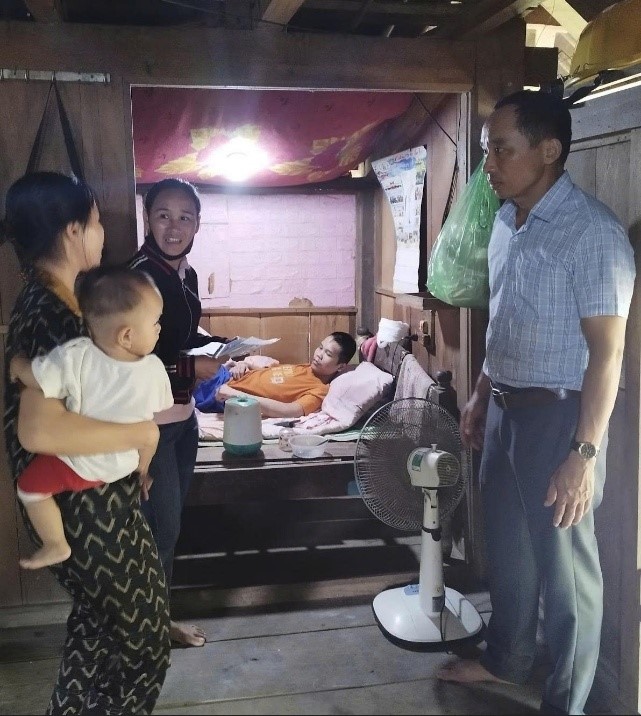
Before support arrived, Doai lay on his bed in a small room, unable to move or take part in daily life outside (Credit: Dam Mai/MCNV)
His mother’s love was boundless, but she lacked the essential tools, the know-how, and, crucially, the hope. Feeding, cleaning, and supporting Doai were all done flat on the bed—no rehabilitation, no expectation of a different life. The crushing silence of abandonment seemed to settle over their home.
Then, the intervention arrived. Since July 7, 2025, the Inclusion 1 project—implemented by Medisch Comité Nederland -Vietnam (MCNV) with support from the US government—reached out.
Every weekend, a dedicated team of technicians and rehabilitation specialists braved steep hills and rough roads to reach Doai’s small house. They began with a thorough assessment. They initiated a rehabilitation plan, provided essential assistive devices, and, perhaps most pivotally, they taught Doai to believe again.
A custom-made rope was fixed, allowing him to pull himself into a sitting position for the first time in years. His mother was enrolled in a comprehensive caregiver training course, reinforced by visits from a nurse at the district health center. She learned to help Doai sit up, to transfer him safely into a project-provided wheelchair, and to push him to the bathroom for a proper shower. For the first time in three years, Doai felt the cool, cleansing rush of water instead of being merely wiped down.
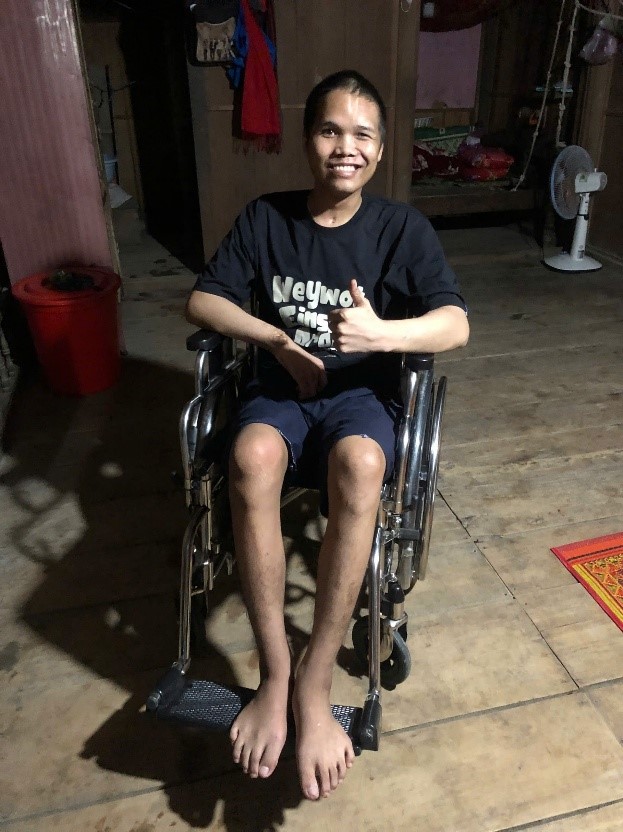
With new skills and assistive support, Doai now enjoys sitting outside in his wheelchair, greeting the world with a bright smile (Credit: Ho Huu Nhan/MCNV)
Today, every morning, Doai is wheeled to the threshold of his house, his wheelchair positioned in the sunlight. He breathes the open air. The dim bulb of his former confinement is now eclipsed by the brightness of the front yard and the possibilities that remain. Challenges related to mobility, accessibility, and livelihoods still lie ahead, but the journey has begun, and the shadow has definitively lifted.
During Quarter 3/2025, thanks to the Inclusion 1 Project, more than 300 people with disabilities in Quang Tri province, Hue, and Da Nang cities received crucial home-based rehabilitation services. Meanwhile, over 250 people received assistive, orthotic, and prosthetic devices to significantly improve their activities of daily living and overall quality of life.
The Inclusion 1 Project is funded by the U.S. Government and owned by the National Action Center for Toxic Chemicals and Environmental Treatment (NACCET). The Center for Creative Initiatives in Health and Population (CCIHP) serves as the managing partner. MCNV is one of the implementing partners responsible for delivering rehabilitation services and providing professional capacity building for health workers./.